

We’re excited to announce Snow Leopard Cloud (beta) — the fastest way to give your AI agents accurate, reliable, and real-time access to your operational data.
Connect one or many SQL databases to Snow Leopard, and your agent can call one API to get the right data from the right source at query time! No MCP servers to build or tune. No context engineering cycles. No ETL or data pipelines. No per-source integration work.
Snow Leopard automatically builds semantic intelligence when you connect a data source, and handles accurate retrieval, intelligent routing, and federation across the connected databases.
Just connect and go.
Operational Data Is Still Slowing Down Agent Development
Coding agents and agent frameworks have dramatically reduced the time it takes to build agents. However, getting those agents to use operational data reliably is a significant bottleneck to shipping production agents. Connecting to databases is the easy part. Consistently retrieving the right data requires significant engineering effort.
To wire up even a single data source, developers typically have to:
Set up and configure an MCP server or database tooling
Explore the schema, relationships, and join paths
Build context around tables, fields, and business logic
Tune prompts and tool descriptions
Test retrieval and iterate on accuracy
Build pipelines or prep data for the AI use case
Add routing and orchestration once there’s more than one source
And that’s for one data source!
Every additional data source means another round of similar tedious engineering work, plus increasingly brittle orchestration between them. Data access and management ends up consuming days or weeks before the agent can do any meaningful work outside of demos, which is a big part of why agent projects stall or fail completely.
Furthermore, getting even “acceptable” data accuracy takes significant effort with multiple iterations of context engineering and testing loops.
Snow Leopard does all that work for you
No MCP setup: Connect your databases directly to Snow Leopard and call our APIs from your agent. There’s no MCP server to build, configure, deploy, or tune — not for the first source, and not for the tenth.
No context engineering: When you connect a source, Snow Leopard automatically analyzes its schemas, metadata, relationships, join paths, naming patterns, and builds semantic intelligence from them. You get high retrieval accuracy immediately, then layer in company-specific context only where it’s actually needed, for fine-tuning.
No ETL or pipelines: Snow Leopard queries your operational databases directly, at runtime. Your data stays in the systems where it lives. There is nothing to copy, transform, snapshot, or maintain, and, no staleness or drift between what your agent sees and source of truth.
Days or weeks of setup becomes minutes. Data and context engineering effort become effectively zero. So your team can spend its time building agent logic instead of wrangling data.
Connect and Go
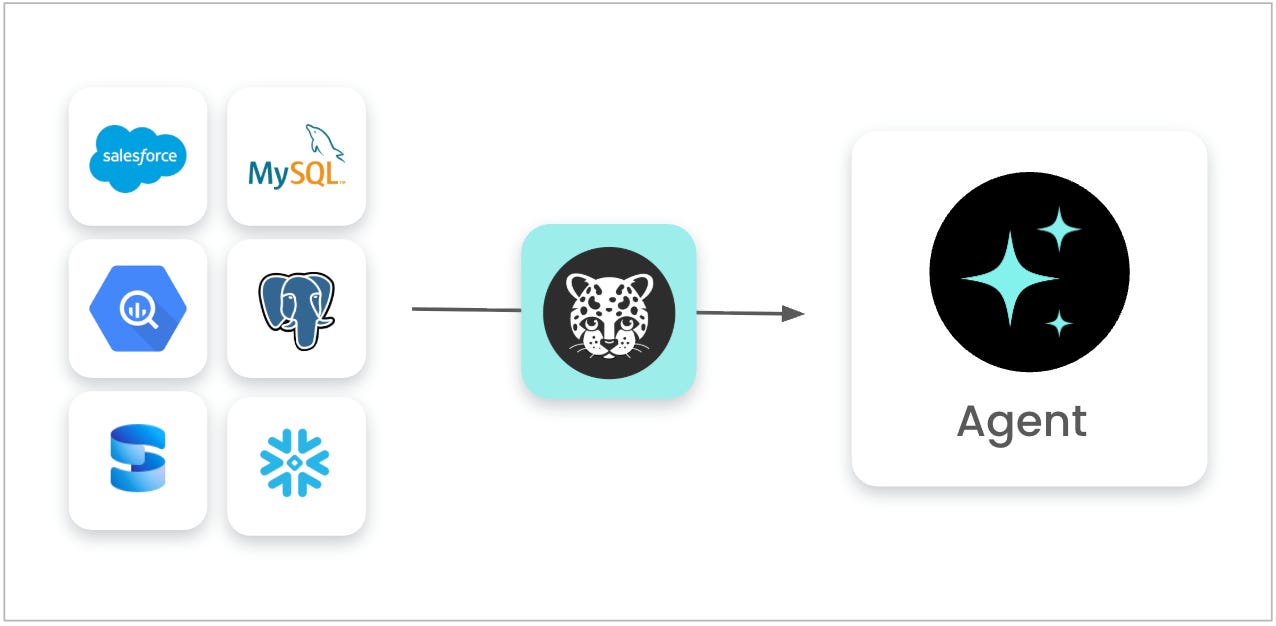
When you connect a SQL database, Snow Leopard analyzes the source and builds semantic intelligence automatically — from the schemas, relationships, metadata, naming conventions, and the structure and logic already present in your data. That understanding powers accurate retrieval from the very first query, with no ontology to define and no metrics layer to hand-author first.
Start with one database, and add more when your agent needs them. Snow Leopard folds each new source into its understanding automatically, with no new retrieval architecture and no new integration project.
This dramatically reduces time to build and ship production agents.
One database or many, near zero effort
Intelligent routing: Your agent simply asks Snow Leopard for the information it needs. Snow Leopard determines in real-time which connected databases actually contain that information and routes the request to the relevant subset — your agent doesn’t need to know or care which database holds what.
Federation across sources: When a single request spans multiple databases, Snow Leopard builds and runs the appropriate dialect-specific SQL queries against each source at query time, retrieves the data, then combines the results to provide the information your agent asked for.
Consider an agent answering a customer question. It might need account and subscription data from Postgres, usage data from BigQuery, and operational data from Supabase. Traditionally, this requires three integrations plus the orchestration logic to stitch them together, with all of that logic sitting within your agent. With Snow Leopard, this becomes one request.
Adding your tenth database to Snow Leopard takes the same effort as adding your first: you simply connect it. No source-specific routing or orchestration logic needed in your agent, at all.
Three ways to build with your data
Retrieve: get accurate data
Your agent can simply ask Snow Leopard for the information it needs. Snow Leopard interprets the request, deconstructs complex questions when necessary, identifies the relevant databases(s), generates and executes the dialect-specific queries, routes to federate the results across sources, and returns the data.
Your agent can focus on the workflow and take the necessary actions. Snow Leopard supplies the live business data those decisions depend on, and when the data isn’t there, it says so clearly instead of inventing an answer. This is a subtle but important factor for autonomous agents to be trustworthy and operate reliably.
Response: get the answer
The response API behaves like a chatbot. It fetches the required data, as it would with the retrieve API, and then constructs a grounded natural-language response with that data to answer the question being asked.
Retrieve gets you the data. Response gets you the answer.
Feedback: tune semantics in natural language
Every company (and departments within a company) has internal “tribal” knowledge that can not be deciphered from the data, metadata, and artifacts around the data. For example, what “active customer” actually means depends on how your team defines it. Marketing and product teams might have different definitions for the same term. The Feedback API lets you supply that context in plain English — business definitions, company terminology, rules, exceptions, metric definitions. Snow Leopard validates and then incorporates that into its semantic understanding of your data.
This is a key difference between Snow Leopard and existing semantic layers where developers have to define the full ontology, encode every business rule, tune retrieval behavior, and build the evaluation harness; all before you can even start on the agent logic, and do this again for every data source.
Snow Leopard builds the semantic foundation automatically. You and your domain experts refine the specific places that need additional internal knowledge, and the system’s understanding improves as you use it. You don’t have to anticipate and encode every possible business rule before you get started.
Get Started with Snow Leopard Cloud
Get started with Snow Leopard Cloud for free! Connect your database(s), call the APIs, and ship your AI agents!
We support the following databases:
PostgreSQL (including AWS RDS, Google CloudSQL)
Neon
Supabase
Google BigQuery
We’re just getting started! Support coming soon for: MySQL, Snowflake, SQL Server, and more operational data sources.
See our Cloud docs for details.
If you’d like to bring Snow Leopard into your on-prem or cloud-prem production stack, we’d love to talk: hello@snowleopard.ai
Subscribe to our blog to follow our journey as we share our learnings!
